Praise to the Jewel in the Lotus – Seek, and you shall find.

image

Leaving a space where one feels happy and content is difficult. However, I had been apart from civilisation for too long, and I was running out of time in Nepal to accomplish my aim, to learn about Tibetan Buddhism. After lots of online research I found another monastery, tucked away in the hills of the Kathmandu Valley. It offered activities such as spending a full day in the presence of a monk, and one to one lessons on the religion, so of course I made a reservation at the hotel attached to it. Elated that I had finally found what I was looking for I headed back to the centre of Kathmandu to look into transportation to Dashinkali, the nearest village to the monastery. Now, usually this task would not prove difficult, with local buses and private taxis available on every street in Thamel. However, my time in Nepal coincides with the current fuel crisis, therefore getting to places that are off the beaten track is not so straight forward any more. The manager of the guest house that I was staying at called a few local drivers for me and they all quoted him very expensive prices. They had purchased fuel on the black market and of course with the increase in price come the increase in their charges, understandably. After several negotiations I managed to settle on a price and, feeling relieved, I arranged to meet the driver at ten o’clock the following morning, my studies were finally set to begin, or so I thought.

To my dismay the driver didn’t show up. I walked to the main street, backpack in tow, and within a fraction of a second I was fenced in at all sides by taxi drivers, my backpack had attracted them like honey attracts bees. I explained to them where I wanted to go and they all looked at me, frowning, and told me I would be better off getting the bus because it was just too much in fuel. So off to the bus station I went. Well, it’s not exactly what I would call a bus station; it’s more like a car park with people shouting out different destinations in rapid, musical speech. There is no ticket desk or timetable, no advice in sight. Now, as I unfortunately can’t speak Nepalese, with the exception of a few words that is, I had no idea which of these buses, if any, would be travelling to the village I needed to get to. So I approached each of the shouting men, who I presumed were the drivers, and asked them ‘Dashinkali?’, ‘No,’ were their replies. Eventually somebody took pity on the helpless backpacker wandering around lost in the bus park. ‘Where do you need to go?’ he asked. So I got out the map and the address of the monastery. It turns out that there are two villages that I could travel to that are near the monastery, Dashinkali and Pharphing, however there are no buses operating to either of these destinations. Feeling disappointed, and homeless, now that I was officially unable to travel to the place I had reserved to lay my head that night, I stood in the middle of the bus park trying to think of a plan B. So, I jumped into a taxi and headed to Boudhanath, which is an area in the Kathmandu Valley where the Tibetan refugees settled when they were exiled from their country, and it is also home to the revered Stupa. Here I didn’t have a teacher waiting for me but I would get to witness the devotees and pilgrims of the religion who come to circumnavigate the stupa and make offerings and prostrations. Wandering around the small streets, squeezing my way between tourists and locals, looking for a place to sleep that night, the weight of my bags seeming to get heavier and heavier, I heard someone calling, ‘You looking for a guesthouse?’ I turned around to be greeted by a huge smile attached to a monk who looked like he could be the Dalai Lama’s twin brother. ‘Yes,’ I replied. So, this helpful monk rescued the homeless pilgrim and proceeded to take me to a guesthouse that was, in his words, ‘very cheap.’

Boudhanath is an atmospheric marvel. The stupa, unfortunately, was heavily damaged in the earthquake but, thankfully, restoration work is currently taking place. Yet despite the damage to this place of worship the people still come from early morning to late evening. A constant flux of monks, nuns, pilgrims, devotees and tourists swirl, clockwise, around the stupa like a whirlwind. The melody of the chants, combined with the music and singing of the beggars, the smell of the heavily scented incense, mingled with the glow of the butter lamps, is intoxicating. Sitting from a roof top, looking out at the action, the mantra of ‘Om Mani Padme Hum’ being carried through the air with every gentle nudge of a prayer wheel, and every little flutter of a prayer flag, you can feel the devotion in your bones. Even if you aren’t religious, or spiritual, or do not believe in the Buddha, the Dharma or any God, this sight will transfix you and being surrounded by it will move you, emotionally. However, despite the fact that I was witnessing Buddhism in practice, and I was immersed in the essence of faith, I still had that niggling urge telling me that I needed to learn more, to study, and as always the student within me won the argument. I was sitting drinking masala chai when, in my frantic search to find another place to learn, I stumbled across the website for the Kopan Monastery. There in big black bold letters, however, were the words DAY VISITS NOT POSSIBLE FROM THE 11TH NOVEMBER. Great, I thought, I bet its past that date. When travelling all days seem to roll into one so I didn’t know what date, or day of the week, it was. I checked the calendar on my phone, expecting to see that today was probably the 12th November. But, to my utter surprise, and when I say surprise I literally shouted out, ‘YES,’ and received lots of funny glares from those around me, the date was the 10th November, meaning that today was the last day possible for day visits. Feeling like I was finally receiving some luck on my quest I set off. I was greeted by welcoming, happy monks and lots of Namaste’s and enquiries as to where I was from. By the time I had arrived there, however, I had missed the Dharma speech, but I didn’t let this spoil my happiness, instead I headed straight to the book store. If I couldn’t find someone to teach me about Tibetan Buddhism in person then the Dalai Lama would have to teach me instead through the written word. Armed with my study books I wandered around the grounds, envious of the students that were rolling in for the month long retreat. Taking the opportunity to start my studying in the peaceful setting, I sat down and started to read. It wasn’t long before someone came and joined me at my table. A beautiful nun, skin golden from her time living in the sun, with warm, friendly eyes adorned with some very fine lines that made her seem even more welcoming. She radiated kindness. I watched her out of the corner of my eye as she turned her head to see what I was reading and then, with a smile which suggested she was happy with my reading material, sat back and closed her eyes. Intrigued by this woman, I struck up a conversation. She was from Australia and had been a nun for over thirty years, ‘Around about the time my hair started to go grey,’ she told me, laughing. I liked her immediately; she was exactly the sort of person I had wanted to meet here in Nepal. ‘Are you a Buddhist?’ she asked. So, I told her my story, how I have an interest in the religion and wanted to study it further here in Nepal. I told her all about my failed attempts and what had brought me here, to Kopan, buying books instead. She smiled with those loving, compassionate eyes and said ‘You know, one day, a teacher will just appear in front of you, and then everything will make sense.’ I smiled, in recognition of the lesson she was giving me with those few words. I needed to let go, everything always works out the way it should and when the time is right I will meet a teacher, just like she said. There was no point worrying, after all worry is just a waste of time, it doesn’t get us anywhere. ‘See you later,’ she said as she walked off to join the monks. ‘Yes, see you later,’ I replied and somehow I knew that I would see her later, I don’t know where or when, but I knew it wasn’t goodbye. She turned around, nodded at me and gave me another of her heart-warming smiles. I guess I did meet a teacher after all.

In stillness the world is restored – my time at the guest house of a Tibetan Buddhist monastery

IMG_7851

As I climbed the one hundred steps in the midday sun, my life on my back, doubt was running through my mind. Surely it would have been easier to reserve a guest house somewhere closer, that wasn’t so difficult to get to? But, all my negativity quickly washed away when I eventually conquered the final step. I stood in the garden and looked down below at the city. Gone were the sounds of traffic, and the day to day heckles of city life. Up here, suspended above civilisation, I had found the tranquil oasis I had been desperately craving since my arrival in Kathmandu. I approached the desk at the reception, red faced and shiny, and dropped everything that was weighing me down. Feeling lighter I smiled at the two faces that were looking at me with expressions void of any emotion. I requested a room on the third floor after reading reviews which suggested that the rooms had the best views of Kathmandu, forgetting of course that it would mean carrying my bags up another fifty steps. I picked up my load again and dragged myself to my home for the next four days, feeling relieved that I could settle for a while and take some time to breathe, to recollect my thoughts and relax. I hadn’t stayed in one place for longer than two nights so far and it was time for me to sit and take in everything that I had experienced on this journey.

The purpose of my visit at the monastery was to hopefully learn about the lives of the monks and to understand more of Tibetan Buddhism. I have studied Buddhism, and I have a personal as well as an academic interest in the religion; however Tibetan Buddhism, which falls under the Mahayana branch, I know little of. Therefore I had planned to spend the remainder of my time in Nepal learning about it, and seeing the religion in practice. The guest house has a school for young novices behind it and as I was walking up the stairs I heard sing-song voices shouting ‘Hello, hello.’ Across, in a room with a glass-less window, in a grey, dull building covered in bamboo scaffolding, were the bald heads of three young smiling novices, adorned in their maroon and orange robes. ‘Hello,’ I shouted back and they responded in giggles. I settled in to my room feeling excited about the learning experience I was about to have. My stay, however, wasn’t the education I had hoped it would be as the older monk’s, ages ranging from late teens to late twenties, seemed to eye me with suspicion. I greeted them every day with smiles; however the smiles I received in return seemed wary. I understood their wariness, I must seem a strange being to these young men. A female, nearly thirty, single and here in a monastery, all alone. I imagine they were wondering what this strange person smiling at them all the time was doing there. I persisted in my efforts to try and befriend the monks however all I could manage from them was the odd, occasional smile. And any effort to try and have a conversation was responded in one word answers. However, despite the lack of interaction with the resident monks which I had hoped to have during my stay, my time there was not wasted. My four nights quickly turned into six as I settled into a relaxed, calm routine, which was exactly what I needed after being on the road, hopping from place to place, for the past couple of weeks. I assimilated to my surroundings and the time scales of my daily routine quickly started to mirror that of the monk’s schedule. I awoke in the mornings to the sound of ringing bells at six o’clock, however as no-one was there to tell me off I sneakily went back to sleep for an extra hour. The chatter of the young novices going about their daily lives at the school re-awoke my lazy eyes and the rest of my mornings would be spent sitting in the garden, under the trees, purple petals showering me, as if from heaven, every time a bird would stop for a rest from its journey. The sun would heat up my body for the day as I watched the butterflies flutter past me and the kites soar above the city against the backdrop of the Himalayas, smiling to myself at the beauty of life. I felt so much gratitude in those moments. Grateful to be alive, to be able to sit in such a magical setting contemplating life, living in the here and now. Occasionally a monk would burst into song, snapping me out of my meditation, and I would giggle to myself when he realised he had an audience and quickly stopped his outbursts. I’m like an alien to them, from faraway lands, sitting here smiling, either in deep thought, reading or writing. I would like to ask them their stories, how they chose this path, however I daren’t ask such a forward, personal question. Sometimes I would feel guilty with my mobile phone and my laptop, my attachments to the outside world, after all Buddhism teaches that desire creates suffering, and by becoming non-attached the cessation of suffering is possible. However, all the monks here have mobile phones, too, and like people back home in the west they walk around with their faces glued to the screen, not looking where they are going. Their material possession makes me feel better about occasionally having my fingers attached to my electrical devices. Every morning the setting created an inner peace within me so profound that I could not entertain the thought of leaving. I was exactly where I needed to be, and despite the wary monks around me, I felt at home in these surroundings. Occasionally the sound of someone shouting from afar would be carried through the air and then the thud, thud, thud of monkeys running away on the tin roofs of the buildings. Their attempted burglaries failed once more. They have attitude these monkeys, they climb and stalk around in gangs, like the teenagers in some parts of England, terrorising people. Evenings were spent listening to a chorus of chanting, laughter, song and music from the young novices. Sometimes there would be tears, like all young boys in schools I imagine they had a falling out over something trivial. Lights out at the monastery is ten o’clock, and this rule I did obediently adhere too, as going to bed early is never a problem for someone who loves sleep, as I do. Before our eyes closed and entered the dream state, however, the choir of the dogs of Kathmandu must first be heard. One howl, then another, and one by one what appeared to be every dog in the city would join in as if they were singing us all goodnight. On my last day in my paradise garden a wasp came buzzing over to me, very soon it was hovering near the eyelashes of my left eye, but the stillness within must have been reflecting outwardly, as after a long period of investigation it flew away, bored of this inanimate object that had once appeared interesting. So, although I hadn’t learned anything about Tibetan Buddhism at the monastery, I did learn to live in the present, to not be concerned about the future, or the past, because they do not exist. What matters is the here and now, and the here and now is an overwhelming feeling of total bliss, of stillness.

Kathmandu, Kathmandon’t?

IMG_7744

Before leaving Pokhara our guide referred to the drive to Kathmandu as a death drive, with steep drops and hair raising bends around the mountains, not to mention landslides. His attempts at persuading us to take an apparent lifesaving short cut by flying instead were thwarted. We had grown fond of scenic road trips and the thought of the drive was more exciting to us than scary, plus we had the utmost faith that our driver would get us to Kathmandu alive. Up we climbed around the bends that we had been warned about, past goat herders and their four legged entourage, and school buses, bicycles and lorries. The mountains were covered in green and yellow ripples dotted with the bright red, pink and blue saris of the women as they collected their bounty. At the highest point on the pass, slightly deaf from my ears popping, I looked down at the valley below and thought to myself this is definitely not somewhere you want to be if an earthquake or landslide hits. So, our guide may have been right about the dangers, but we were also correct to place our faith in our driver as we made it to the city alive and well.

As we approached the busy streets of Kathmandu I was filled with a sense of nostalgia, gone were the lush green mountains and flowing rivers, our rural scenic adventures in Nepal had been replaced by traffic and pollution. I hadn’t left the vehicle and I already wanted to leave. Maybe our guide sensed my reluctance to be in urban surroundings as, rather than taking us straight to our hotel, he de-toured to the Monkey Temple, Swayambhunath, and if anywhere in the city was going to change my mind it was of course going to be one of the most famous Buddhist temples in Kathmandu. Entering the temple the thoughts of the mountains were pushed to the back of my mind, prayer flags and monkeys taking over my attention. When the earthquake hit I had imagined that I wouldn’t get to see Kathmandu’s famous sites however, despite some damage, the stupa was still glorious and a sight to behold. I managed to walk around the grounds with only one attempted robbery by a monkey. After he grabbed the bottom of my trousers I told him I had no food and he let go, others however were not so lucky.

After an early morning alarm we made our way to the airport to get up close and personal with the mighty Everest. We had booked a flight with Yeti airlines and had been warned that delays were possible because if the mountains weren’t visible then we wouldn’t take off. An Everest flight without seeing Everest was obviously pointless. Luck, it appeared, was on our side. I guess the mighty mountain wanted to show off her beauty to us because our flight departed on time and there wasn’t a cloud in the sky as we faced her head on. Relaxing on the flight with a glass of champagne may seem like cheating to those hardy mountain climbers, however, not all have the skill to climb those dangerous peaks, and going to Kathmandu without seeing Everest just felt wrong. So, I gazed out at the summit of the world’s highest mountain, filled with bubbles and happiness, and feeling extremely grateful that I was seeing something that many people in the world dream about seeing.

We came back down to earth with a soft thud and headed back to the busy streets of Thamel where we wandered around taking in the sights, smells and sounds of the city. Kathmandu Durbar Square had been badly damaged from the earthquake; however we had expected to see more destruction in the centre. It was when we visited Bhaktapur, however, that the extent of the damage was evident, with the ancient buildings being held up by wooden beams and piles of rubble scattered across the area. Yet despite the beautiful and interesting buildings around Kathmandu, my soul craved some peace, so I said goodbye to the wonderful people I had been travelling with on my tour for the past 15 days and headed off, alone once more, to the hills overlooking the city, for some rest and relaxation at the guest house of a Tibetan Buddhist monastery.

Where there’s water, there’s life – Sunrise and rapids in Pokhara

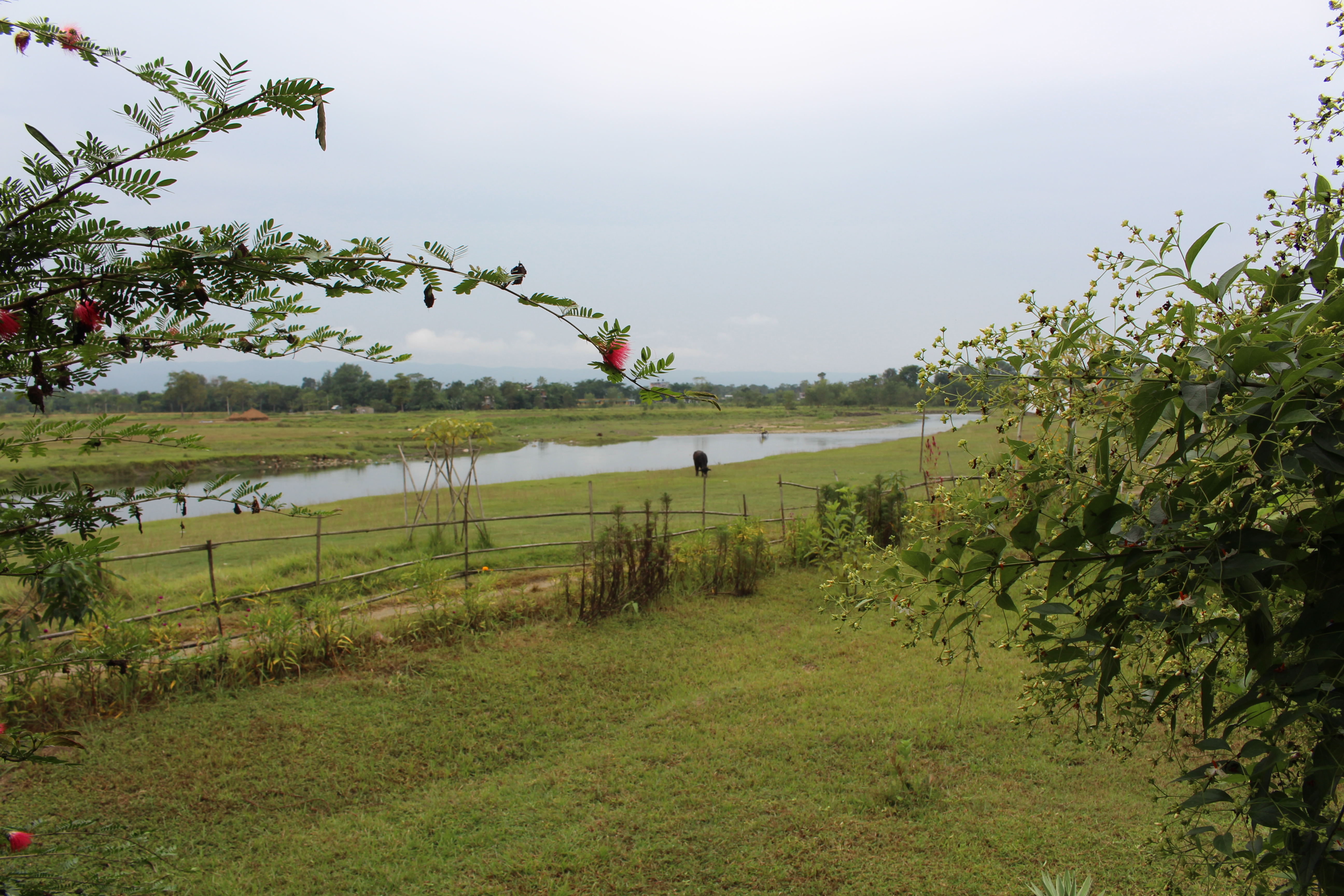
IMG_7620

Standing on the banks of the river, the water buffalo strolling behind me, and the shadow of the Annapurna’s lingering on the horizon, I said my silent goodbyes to the Tharu village and to the beauty of Chitwan. Our time at the park felt brief, and there was part of me that was reluctant to leave, however Pokhara was calling my name and I was looking forward to travelling further into Nepal to discover more of the country I was growing so fond of. The village had come out to see us off and on the drive out of the park we passed children on their way to school, waving and shouting ‘Goodbye, goodbye.’ It wasn’t long before the melancholy I felt at leaving such a welcoming place was replaced by awe and wonder at the sight of the green domes surrounding me and the emerald waters running through them. The water, foaming with white, looked inviting and it seemed a travesty to keep driving through the land rather than stopping to take a dip. After only a short while into our journey we came to halt on the mountain pass, a landslide of rocks and debris was blocking the road ahead, so we patiently waited for it to be removed before we continued on our journey. We passed small villages that scattered the landscape and more children with their braided pigtails, carrying their books, on their way to school. Streams flowed down the hills and the locals made use of the fresh, clean water to wash their clothes and themselves. We eventually passed a sign welcoming us to Pokhara, the first densely populated area we had come across in the country. Being much more comfortable in the countryside than in big cities I surprisingly felt at ease on the spacious streets, possibly because from every angle I could see the peaks of the Annapurna’s, who appeared to be guarding over me. It was in Pokhara that the first signs of the earthquake became evident. I had expected, before entering Nepal, to see a land full of destructed buildings, however the only evidence so far of the devastation was a former restaurant that had been reduced to rubble.

After waking up under the roof of the stars we set off on a journey up to Mount Sarangkot, to witness a Himalayan sunrise. Eyes half open, and weak from lack of fuel, we climbed our way to the view point only to be greeted by what appeared to be every tourist in the city. Unimpressed so far, due to lack of sleep no doubt, we waited impatiently craving coffee and a pillow for the sun to make an appearance. All negativity was washed away when the shadows of the mountains appeared under the pink glow of the rising sun. Finding a spot without having a line of heads also covering the horizon proved futile, however the mesmerising beauty of the scene overshadowed all the chatter and selfie sticks. It turns out that a Himalayan sunrise is worth missing sleep and breakfast for after all. The snowy peaks of the Annapurna’s fully visible we made our way back down the mountain to explore another activity on offer in Nepal’s capital of extreme sports, white water rafting.

As we stood by the flowing waters of the Upper Seti River, paddles at the ready, listening to the safety speech from our guide, the nerves started to kick in. After listening to his advice only one thing was in my mind ‘DO NOT FALL OUT’. Falling out, as I interpreted it, would mean landing on a rock and imminent death by drowning, despite all the people there to rescue me. We were also advised that our rowing technique should be strong and powerful like a Vikings and not, as our guide explained, like an English person gently rowing down the river thinking about afternoon tea. So it turned out that as I was in a raft with Viking companions from Norway, Sweden and Germany, I had a lot to prove. All fears of death were quickly diminished as soon as the raft started its way downstream, the adrenaline kicked in and team Viking were powering through the rapids with ease and lots of roars and laughter. Waves of icy river tried, and failed, to drag us into its depths and we not only made it to the bottom alive, but also high on life and wanting to go back and start it all over again. White water rafting turned out to be the best part of our trip and we all vowed that we would definitely be doing this activity again somewhere, with higher grading of course because we were so damned good at it.

Rhino’s and tigers and bears, oh my!

IMG_7513

There is something incredibly special about waking up to the sounds of nature, instead of traffic and alarm clocks. I opened my eyes in time to the cockerel letting everyone know it was time to start the day, the sound of the goats on their way to get breakfast, and the sun lightly shining through my window. The first task today, in order to spot wildlife, was a canoe ride. When we arrived at the river a baby elephant greeted us. Now, seeing a baby elephant in the wild has always been at the top of my wildlife wish list so, for me, this moment was like waking up on Christmas morning to discover Santa had been and left you a room full of presents. I literally jumped out of the car and ran to the elephant to get a closer look, but I soon discovered that this beautiful baby had come from an elephant breeding centre in the jungle. He had been born so that one day he could carry hordes of tourists on his back as they explored the jungle looking for wild animals. The irony of this certainly isn’t lost on me. I took some comfort in the fact that he would never have known what life was truly like in the wild, therefore never experience a longing for it. I just hope and pray that he would never be mistreated. Elephants, when taken from the wild, are beaten in cruel ways in order to get them to perform, but the elephants in Chitwan, as far as I could see, were well looked after by the people taking care of them. There was never any sign of mistreatment. I just hope my observations were true and behind closed doors it isn’t a different story. After leaving the little baby behind we wobbled into our wooden canoe, the water was nearly level with the top of the boat, and I slowly and nervously sat down hoping I wouldn’t topple the boat over. We ventured down the river, the boat being manoeuvred by the local man stood at the back rowing with his giant piece of bamboo. We were surrounded by jungle at all sides, the bright blue of Kingfishers zooming across our eyes, and eagles and peacocks perched on the branches of the giant trees watching over us. It wasn’t long before the bamboo stick was pointing towards something in the water to my right. ‘Crocodile, crocodile,’ he cried. Seven heads swung around in the direct of the end of the bamboo stick, and sure enough, there right beside us in the water were the eyes of a crocodile. Its jaw was level to the top of our canoe. Cameras clicked away trying to collect evidence of our first glimpse of a crocodile in the wild, just in case we didn’t get that lucky again. We didn’t need to worry; the further down the river we sailed the more and more crocodiles came out to greet us. Soon we had lost count of the numbers and we made it out of the boat, and onto dry land, without accidently falling in the water and becoming crocodile breakfast.

After spending the rest of the morning learning how to basket weave in the village with the women it was time for part two on our wildlife mission, a jungle safari. This was when we were hoping to see the big animals, rhino’s and tigers and bears, oh my! Seated in the jeep, cameras at the ready, and our eyes focused on the vegetation surrounding us, we set off. Or should I say, we zoomed off, because we appeared to have the Nepalese version of Lewis Hamilton driving our vehicle. Our jeep safari, where we were trying to spot animals in the wild, was more like flying around a Formula One race track and the jungle surrounding us turned into nothing but a green blur. ‘Are we supposed to be going this fast?’ I asked. Being a safari novice I wasn’t sure on the protocols or speed limits. My travelling companions, however, had been on safari’s in Africa and they looked at me worried in response and shook their heads. A few times en route we managed to spot, and I can only assume it was by a miracle, a few deer and wild boar, but there was no sign of any of the big animals we were desperate to see. There is never any guarantee of seeing animals in the wild, and all in the jeep knew that, however we had been so excited about the potential of seeing these glorious and endangered animals that we couldn’t help feeling deflated after four hours of hoping and praying. It was only on our way out of the park that Hamilton decided to slow down and just when it seemed all hope was lost a girl in the group whispered, ‘Rhino.’ The engine stopped and we peered over to the right, following the direction of her finger, and found a patch of grey hidden in the bushes. ‘Rhino,’ repeated our guide. We crept further up the path giving this giant, one horned, marvellous creature room to cross the path without being in his way. We stood, the hairs on our arms standing on end, in complete silence. We watched as he came out of the bush to stand straight in front of us, giving us the perfect view of him, with no jungle obstructions. I am pretty sure he was thinking ‘go on, take a look, get your pictures and then leave me to eat in peace.’ So that’s exactly what we did and as we left the park behind, filled with a huge sense of happiness and relief, I said a silent thank you to God, the rhino and to the girl who spotted him. We may not have seen a tiger, but I am pretty sure that hidden somewhere in the deep, dark bush, a pair of yellow bright eyes had definitely seen us.

Into Nepal, into the jungle…

IMG_7349

I was eager to see Nepal, a country completely new to me. I was also eager to see the border between Nepal and India having never crossed a land border before. I expected major delays due to the current fuel crisis in the country, and queues there were for vehicles, however crossing on foot wasn’t a problem. I didn’t anticipate that there would be such a difference between the two countries so soon, them being only a few feet away from each other, but the difference was there. It could be felt instantly as soon as we were on Nepalese soil. For one it was raining, and for the first time in my life I didn’t get the urge to run in doors and cover up, I welcomed the rain. The soft, gentle, cool drops were exactly what my overheated skin needed. The second stark difference was the silence, and I don’t mean total silence, I mean the lack of car horns. Anyone who has travelled to India will understand what I mean, it is one of the things I love about the country, the chaotic traffic and the constant beeps from every vehicle passing by. But sometimes, just sometimes, the silence is a welcome break. And so, with our visas approved, we walked into wet and peaceful Nepal excited to explore and see what the country had to offer.

The first stop on our itinerary was Lumbini, the birthplace of the Buddha, but unfortunately recent events meant that the town was blocked off from visitors, as previous groups had been unable to leave the town due to protests and our schedule just didn’t have time for a 24 hour block in. So, we made our way through mountain roads, with steep drops into the jungle below, to Chitwan National Park. Driving through rural Nepal is a wonderful experience, and because the countryside is so beautiful you quickly forget that you are in a vehicle from 6 to 8 hours. Lush, green vegetation and colourful houses are dusted across the land, with milky aqua rivers curving through the mountains. The higher the climb the steeper the drops and we witnessed many rainbow coloured lorries that had slumped down a ditch and toppled over. Despite this, however, the drivers of different vehicles seemed to navigate the roads between each other safely and considerately, driving slowly and stopping in tight spots to ensure that others could pass them by. We were due to stay with a local tribe in Chitwan, a community homestay, and on arrival the women from the village came out to greet us dressed in their traditional outfits, clapping us as we walked towards them where we were given a hibiscus flower and the traditional red powder dotted onto our foreheads. We would be sleeping in small huts that had been purpose built for tourists by the side of the river and the excitement rose as we discussed the possibilities of seeing the different wildlife that the park inhabited. ‘Are there crocodiles here?’ we asked. ‘Yes, there are crocodiles.’ Our eyes darted to the river in search of them, something was swimming across to the opposite side of the bank making ripples in the water the way the shape of a crocodile would. We waited for its arrival on land, but it was only a water snake. We brushed off the disappointment, mission see- a -crocodile -in -the -wild wasn’t over yet.

After we dropped off our bags, and freshened up after our long journey, we walked across the rice fields to the Tharu village, the Tharu’s being our hosts, to be taken on a bike ride through the villages. On our walk across we were met by a small black dog that proceeded to guide us to our destination. This was starting to become a common occurrence on this trip, as if the dogs could sense our lack of direction and therefore came to ensure our safe arrival. It had started to rain again as we hopped on our bikes, trying to keep our balance over rocks and stones and huge holes in the road. We had gathered a few extra local cyclists behind us who got the giggles when an ambulance veered round the corner and, due to a lack of brakes, we all crashed in to the back of each other. Unharmed and filled with a sense of adventure we hopped back on, wobbled a little, but eventually found our equilibrium and were greeted by the sounds of ‘Namaste, Namaste,’ by every person, adult or child, that we cycled past. The friendliness of the locals, and the fun we were having, meant that the little speckles of rain couldn’t dampen our spirits. With the wind blowing in my hair, and the sense of freedom and happiness at being amongst these special people, I floated through the bumpy roads feeling the most happiness I had felt so far on this journey. Half way through our ride we stopped at the entrance to the national park to see if we could spot any wildlife. A short walk into the park and we came across a wild boar and a deer and then a local man approached our guide to inform him that a rhino had been spotted further up by the water’s edge. We hurried, as quietly as possible so as not to disturb the rhino, up to the spot he had been seen and hid in the bushes, waiting. Time ticked on; there was no sign of him. Still we waited, not daring to move in case he finally came out and showed his face. Then another group of tourists came along, who obviously didn’t get the memo about noises scaring away the animals, and after listening to their extremely loud conversation we realised that there was no point waiting around anymore. If the rhino was there, he definitely wasn’t now after that racket. We made our way back to the bikes determined that tomorrow we would definitely be more successful, and not only would we see a rhino, but we absolutely would see a tiger, too. Positivity ran through the group as we headed back to the village where we were due to be entertained by the villagers who were performing their traditional stick dance in order to welcome us. Little did we know at the time, however, that we would be part of the performance. The women were bundled off with the women of the village where they proceeded to dress us up in their traditional attire, complete with a makeover and hair extensions. A few giggles were thrown in for good measure as they tried to fit their small pieces of clothing around our much bigger western frames. Every man, woman and child from the village had come out to witness our welcoming and a few more giggles were heard as we entered the crowd in our new outfits. The men of the group got to kick back, relax and watch the show whilst the females got up to take part in the dance, and in my case tried and failed to master the moves. Despite my lack of co-ordination skills the night was a huge success and after lots of smiles, laughter and group photos we made our way back to the huts for some much needed sleep. Tomorrow we would be seeing crocodiles, rhinos, bears, tigers, and every wild animal in the park. We would, we absolutely would. So we told ourselves.