The Killing Fields and Tuol Sleng Genocide Museum (S-21 Prison)

photo

Ever since seeing the movie with the same name I had wanted to visit the Killing Fields, to pay my respects to the people that lost their lives there, and to learn about this dark period within the living memory of Cambodian history. The long drive through the countryside to Phnom Penh was a stark contrast to the place I was about to visit. On both sides of the road there was an endless expanse of the brightest green grass, combined with the most intense blue sky I have ever witnessed, on the horizon. Whiter than white fluffy balls of cotton floated in the sky. It was like I was looking at a photographic image and the saturation had been turned up, full. The countryside of Cambodia, combined with the friendliness of its people, is what makes this place so special. It is hard to believe that people who were faced with such an incredible view of beauty every day could find it in their hearts to be so cruel to people when all I felt, looking out at this landscape, was an unequivocal wave of love.

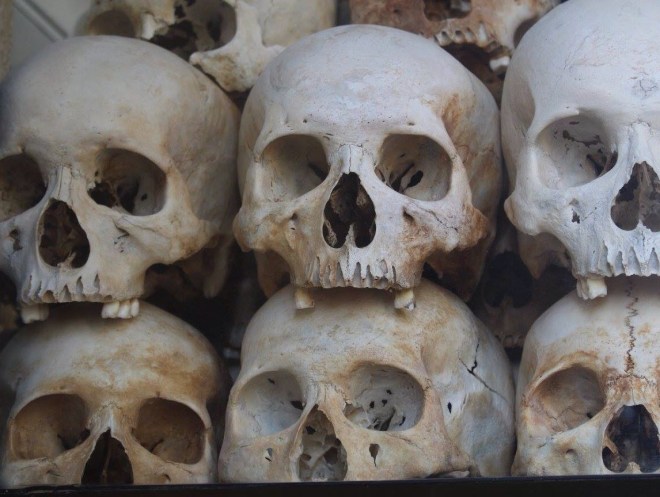
As we approached the Killing Fields our guide explained to us how his family had been affected and how many people he had lost during the Pol Pot regime, that’s when the reality started to hit home. This wasn’t just a tourist attraction, this was a place where unimaginable horror had occurred and innocent people, including women and children, had been brutally murdered. Seeing the skulls of the victims was an eerie experience; however there was an unexpected feeling of peace there, too. I made an offering of incense and flowers to the lost souls and walked around gently, eyes filled with tears as I saw bones and teeth in the ground and clothes of victims so small that they could only fit a baby. The stories of how the guards smashed baby’s heads against the tree trunks to kill them to save on ammunition was just too much to bear.

After the Killing Fields we made our way to the S-21 prison and walked around the cells hearing the stories of how the prisoners were treated. Unexpectedly, as we were leaving the site, we were approached by one of the very few survivors from this prison. His name is Chum Mey and, through a translator, he told us how he was treated by the guards. How they twisted off his toe nails with pliers and how he was made to lick his own urine from the floor if the very small bucket the prisoners were given as a toilet overflowed. It was awful to hear how this smiling old man was treated, how anyone could be so cruel to him. But it was also very uncomfortable to see him have to retell these unimaginable horrific stories over and over again to tourists as he stood taking photos and trying to sell his book. It seemed that he had become a tourist attraction when, in my opinion, this man should be able to live in peace for the rest of his life instead of having to relive those memories over and over again. And still it seems that our species hasn’t learnt from the horrors such as those that occurred during the Pol Pot regime, there is still no peace in the world. I only hope that one day there are no stories, like Chum Mey’s, to tell.

Angkor Wat, Angkor Not?!

12249834_10207976722956565_3686126243926670582_n

There was nothing but darkness and tourists as we approached the steps by the waterside in front of Angkor Wat to watch the sunrise. Our intention was to get there early and try and get a good spot, a clear view of what we had come to see without a line of heads in front of us. I managed to squeeze through the building crowd and find a patch on the final step, next to the water’s edge. I would be eaten alive by the mosquitos that had invaded the waters, but it was a small price to pay, in my opinion.

Slowly the sun started to rise, quickly the crowds started to gather. And as I sat watching the sky change from black, to purple and pink to orange, the silhouette of Angkor Wat in full view, the excitement rose with anticipation at finally getting to explore this mysterious looking complex. I imagined myself as Lara Croft finding hidden pathways and tombs. After the sun had brought its glow to the watchers below it was time for this very disappointing tomb raider to adventure to Ta Prohm. Our guide, Hang, had explained to us that we would start with what is known as the Tomb Raider temple first and we would visit the actual Angkor Wat temple last.

Wondering around Ta Prohm was fascinating, and the site is sure to make anyone feel like an explorer who has found a hidden tomb in the middle of the jungle, even if no secret passageways appear underneath your feet. Aside from the few tourists and a few scaffolding bars holding parts of the complex up, it felt like we were the first intrepids to venture into this hidden jungle climbing frame. After exploring the area, whilst dodging huge spiders, and singing along to Johnny Cash with our guide we headed over to Angkor Thom, and the temple of Bayon. As we approached we spotted a group of mild and friendly macaques by the side of the road, they had obviously realised that being nice to tourists meant being fed a constant flux of bananas and lotus roots, a far cry easier than going out looking for food. We eventually dragged ourselves away from the friendly monkeys when we realised that the more time we spent with these adorable animals, the more people were arriving by the coach load.

Climbing up to Angkor Thom, the stairs made to fit the feet of a three year old, I was blown away by the sight in front of me. Hundreds of faces of the Buddha were watching me from every angle. Every carving, so intricate and clear, which, considering this building was made hundreds of years ago when modern tools were not available, was astounding. The time and dedication it took to build this is awe inspiring. However exploring hundreds of years old temples in the Cambodian humidity is not easy and by the time we had reached the top of the complex we were all slowly starting to lose our energy, heat exhaustion didn’t seem to be too far away. Alas we dragged ourselves to the main attraction, Angkor Wat; however by the time our fatigued bodies reached the temple we were absolutely worn out, we tourists didn’t even have the strength to take a photo, a sure sign that the energy and enthusiasm present only a few short hours ago had been sucked away completely. Angkor Wat had turned into Angkor Not. The complex, even though it’s the biggest of the temples, is far less impressive than Ta Prohm and Angkor Thom so we were grateful that we had seen the best (in our opinions) that the attraction had to offer before we lost all ability to lift our feet up off the ground. Despite our exhaustion we knew that if we didn’t drag ourselves up the very steep steps to the top of the building then we would always regret it, so, one by one, we pulled ourselves up step by step. The incredible 360 view of the area was a small comfort to us and I just about managed to muster enough energy for a few more photos, then it was time for these weary travellers to climb down and head straight to an ice cold air conditioned bus. The moral of the story, listen to all the guide books, don’t attempt Angkor Wat in one day, take your time, relax, explore without the risk of dying from Cambodia’s intense humidity levels.

Smiles through adversity – New Hope charity, Siem Reap

photo

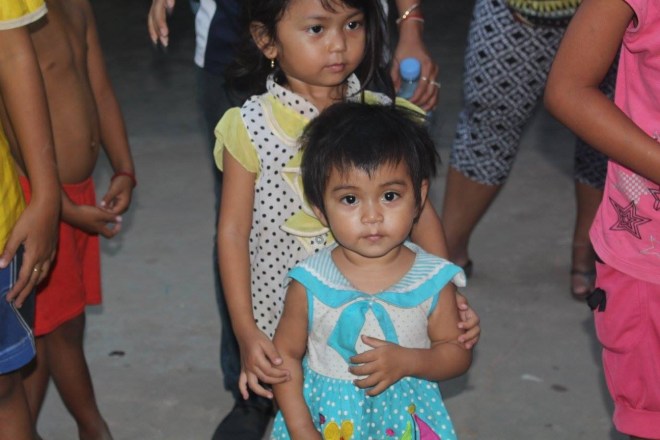
As we entered the slum area of Mondul 3, in Siem Reap, the children sitting by the side of the road greeted us with waves and ‘Hellos.’ The rocky, uneven surface of the roads slowed down our pace which provided a young boy just enough time to be able to jump on the back of the vehicle and come along for a ride. With the wind blowing in his hair, and eyes, he laughed, with a grin so wide that one couldn’t help but join in with the laughter, too. The further into the area we travelled the bumpier the ride became until, that was, we came to a halt and as I placed just one foot on the ground my hands were gripped by tiny fingers pulling me along to come and play. Surrounded by smiling faces I became a human climbing frame, with a child on my back and one swinging from my arms and one clinging to each leg. This was, without question, the friendliest, happiest greeting I had ever received and I instantly felt overwhelmed with joy. Some of these children had been born with HIV, some of them had parents who had tried to sell them for as little as $100 out of sheer poverty and desperation. Yet, despite all this, they were without doubt the happiest children I had ever met throughout my travels.

The young woman working for the charity gave a speech to explain the work they do however the children were more interested in distracting their new playmates and the sounds of their cheers and laughter drowned out the poor girl’s voice. We did our best to listen, however paying attention isn’t easy when your arms are swinging children up in the air and there is a child climbing up on to your head to try and reach the tree. After the unheard introduction the children performed some songs they had learnt during their English lessons and we were all soon joining in to ‘Heads, shoulders, knees and toes’.

When it was time to leave, in order to visit the new school building, we had to physically peel the children away from our bodies, which was hard as they were obviously having so much fun and didn’t want their new playmates to leave. Seeing the amazing work being done here was so uplifting, but there is still work to be done. If you are interested in helping this charity you can find more information at www.newhopecambodia.com